
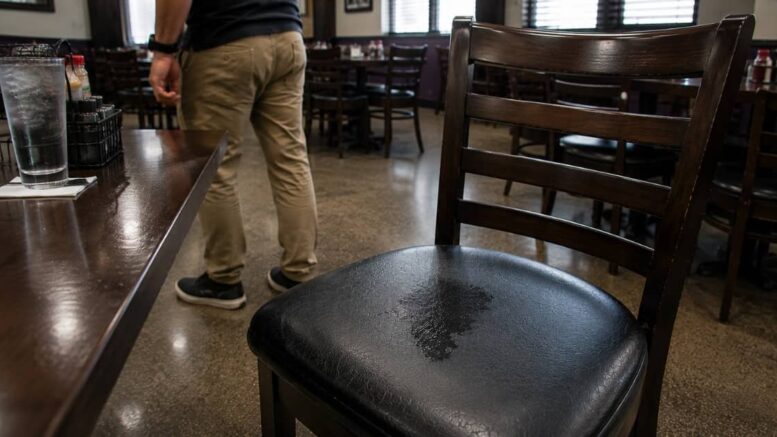
A new study has found that 94% of New Orleans residents instinctively look back at their chair after standing up, primarily to assess what, if anything, they have left behind.
Researchers observed more than 1,200 people at restaurants, festivals, parks, offices, bars, classrooms, waiting rooms, and other locations throughout the metro area and found the behavior increased significantly alongside temperature, humidity, and the amount of time participants had been sitting.
While outdoor seating produced the most severe cases, researchers were surprised to find the phenomenon remained widespread indoors, including in heavily air-conditioned buildings.
“People assume once they get inside they’re safe,” lead researcher Dr. Kimberley Legendre explained. “They’re not. Sometimes you’re just sitting there finishing what you started outside.”
Researchers have formally named the behavior post-seating visual inspection, or PSVI.
“The glance itself is almost involuntary,” Legendre said. “What happens afterward depends entirely on what they find.”
According to the study, most inspections occurred within one second of standing. When alone, participants generally turned around and openly examined the chair. In public settings, however, the team also noted increasingly elaborate attempts to disguise the inspection.
Common evasion techniques included pushing the chair under the table, checking beneath it for something they definitely didn’t drop, pretending to hear something behind them, or performing a casual 360-degree scan of the room.
Researchers classified all four behaviors as looking at the chair.
Of those who looked back, 87% were checking for visible butt sweat. The remaining 13% claimed they were just making sure they didn’t leave anything, a statistical anomaly researchers flatly classified as lying.
The study also documented what researchers call the pants check, in which subjects discreetly touch the back of their clothing before inspecting the chair.
“It usually begins with a brief period of uncertainty,” Legendre said. “Essentially, ‘Did I pee myself? Nah, that’s gotta be butt sweat. Right?’”
Researchers said relief typically followed once participants determined they had merely sweated completely through their clothing.
“This is one of the few circumstances where discovering you have an enormous amount of butt sweat is considered the favorable outcome,” Legendre said.
The team found the phenomenon crossed virtually every demographic group studied, with no meaningful differences based on age, income, occupation, or social status.
“Prom queens, panhandlers, lawyers, line cooks, tourists, city councilmembers,” Legendre said. “Everybody got it.”
The only significant difference was how people handled the aftermath.
Researchers developed a classification system for the marks based on what they described as “anatomical specificity.” While faint impressions produced little reaction, near-complete outlines triggered immediate cover-ups, usually involving aggressively shoving the chair back under the table.
The study found several other mitigation strategies, including casually wiping the seat with a hand, napkin, or forearm. Participants were significantly more likely to clean the chair when a nearby cold beverage offered a plausible alternative explanation for the moisture.
Researchers called this beverage-assisted plausible deniability.
“You move the glass over, wipe down the chair, and suddenly nobody knows where the water came from,” Legendre explained. “Nobody believes you, obviously. But you’ve established reasonable doubt.”
Black pants were also found to provide participants with significantly greater emotional confidence despite offering little actual protection.
In more severe cases, researchers observed subjects quietly asking a trusted friend, “Can you see it?” before turning around and presenting the affected area for inspection.
Friends overwhelmingly responded with some variation of “No, you’re good,” regardless of whether the person was, in fact, good.
Researchers stressed that butt sweat is a normal physiological response to living in New Orleans and said residents should feel little embarrassment about leaving evidence behind, indoors or out.
“Nobody is judging your chair,” Legendre said. “They’re worried about theirs.”