
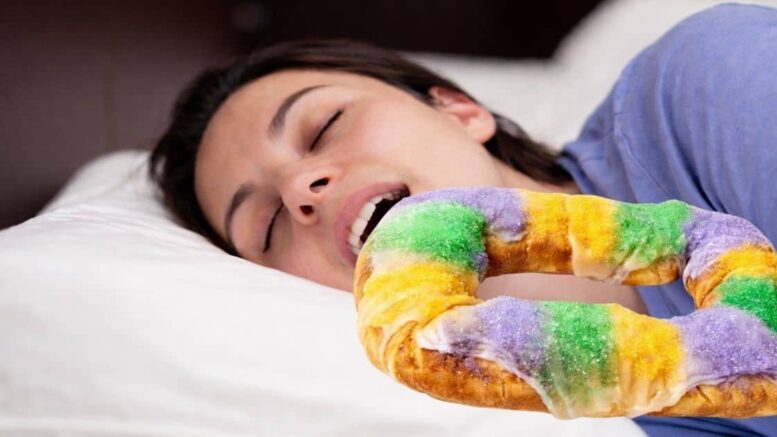
A newly released regional sleep study has confirmed that the average Louisianan unknowingly consumes approximately eight full king cakes per year while asleep, most commonly during Carnival season.
The study was initiated after healthcare professionals across the state reported a rise in patients presenting with unexplained seasonal symptoms, including elevated blood sugar, sudden weight fluctuation, and a persistent feeling of being both overstimulated and inexplicably sluggish.
“At first, we assumed it was lifestyle related,” said Dr. Lionel Boudreaux, who claims expertise in circadian bounce and rhythms as a side hustle. “Diet, stress, maybe a little more social eating than usual. But nothing patients described accounted for the numbers we were seeing.”
Patients reported eating normally and in moderation, citing the occasional candy bar, a few cookies at home, or a single slice of king cake at the office. None believed their habits could explain the results.
Researchers then invited participants to take part in an in-lab sleep study to better understand the discrepancy. Patients agreed, confident the findings would confirm their self-assessments.
According to the report, participants were monitored overnight and later informed by researchers that they had, in fact, consumed multiple king cakes during periods of sleep, despite having no memory of doing so.
“None of the participants were aware they had eaten any,” Boudreaux said. “They only knew because we told them.”
The study found the phenomenon occurs without conscious awareness and does not require individuals to recall acquiring king cake in the first place. In several cases, participants were unable to account for how king cake entered their homes prior to the study.
“Some were adamant there was no cake involved at all,” Boudreaux said. “Cake was present.”
Most incidents were found to occur between midnight and 4 a.m., when participants were fully asleep and baked goods were least defended.
Researchers observed no signs of wakefulness during consumption, describing the process as automatic and memoryless, leaving behind only crumbs, an empty box, and no behavioral indicators the following morning.
The phenomenon was consistent statewide, cutting across parish lines and bakery loyalties.
Researchers noted the findings were somewhat unexpected, given Louisiana’s otherwise strong health profile, and said continued monitoring would be necessary to ensure the state’s rankings do not decline.